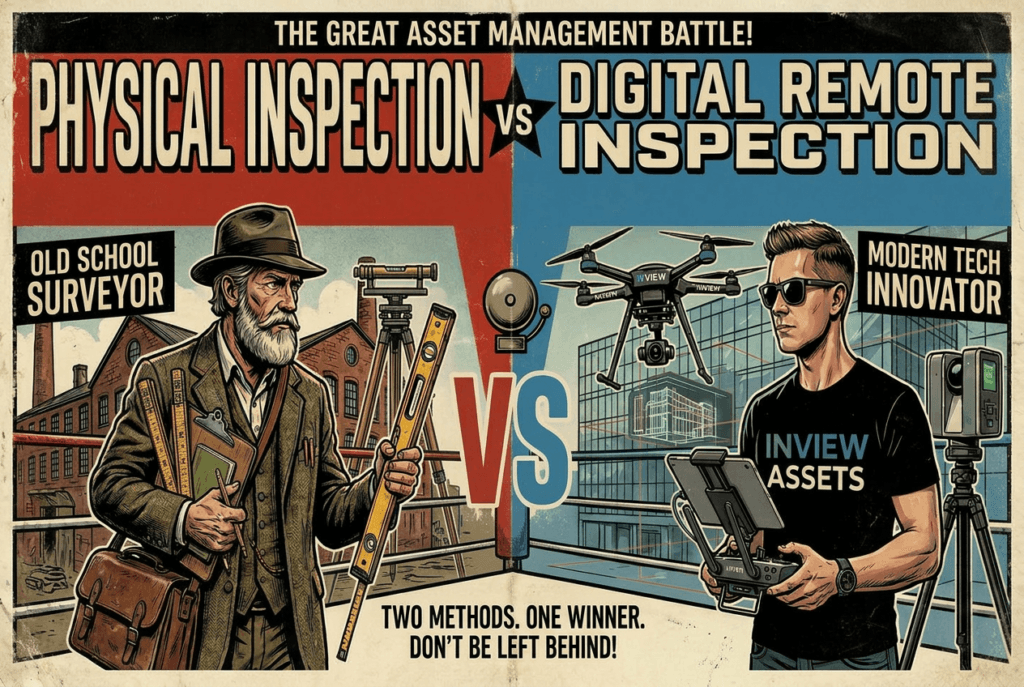
When was the last time your business or organisation paid for a surveyor to travel to site, climb a ladder, and spend a full day documenting what a camera and smart software could have captured in a fraction of the time and at a fraction of the cost?
If you’re still relying solely on physical, boots-on-the-ground inspections to manage and maintain your building assets, it’s worth asking: is this really the most effective, efficient, and safe way to operate in 2026?
The built environment is undergoing a fundamental shift. Digital transformation in asset management is no longer a buzzword reserved for tech companies, it’s reshaping how UK property owners, facilities teams, and asset managers approach the inspection, monitoring, and long-term stewardship of their buildings.
At InView Assets, we believe there’s a smarter approach. Here’s a clear breakdown of how traditional physical inspections compare to digital remote inspection and why more organisations across the UK are making the switch.
What Is a Physical Inspection?
A physical inspection involves trained personnel, usually a surveyor, visiting a site in person to assess the condition of a building asset. This might mean inspecting rooftops, facades, structural elements, plant rooms, or hard-to-reach infrastructure. Inspectors or surveyors record their findings manually, take photographs, and compile reports often over multiple visits.
It’s the traditional method, and for decades it was the only method. But that’s no longer the case.
What Is Digital Remote Inspection?
Digital remote inspection uses a combination of technologies including high-resolution drone imagery, 360° cameras, photogrammetry, thermal imaging, IoT-connected sensors, and cloud asset management platforms, to capture, analyse, and report on the condition of a building asset without requiring personnel to be physically present on site.
At InView Assets, our asset management platform delivers comprehensive, measurable, and easily accessible asset data all from a secure online environment that your whole team can access, anywhere, at any time. Think of it as your entire building estate, fully documented, digitally tracked, and always up to date.
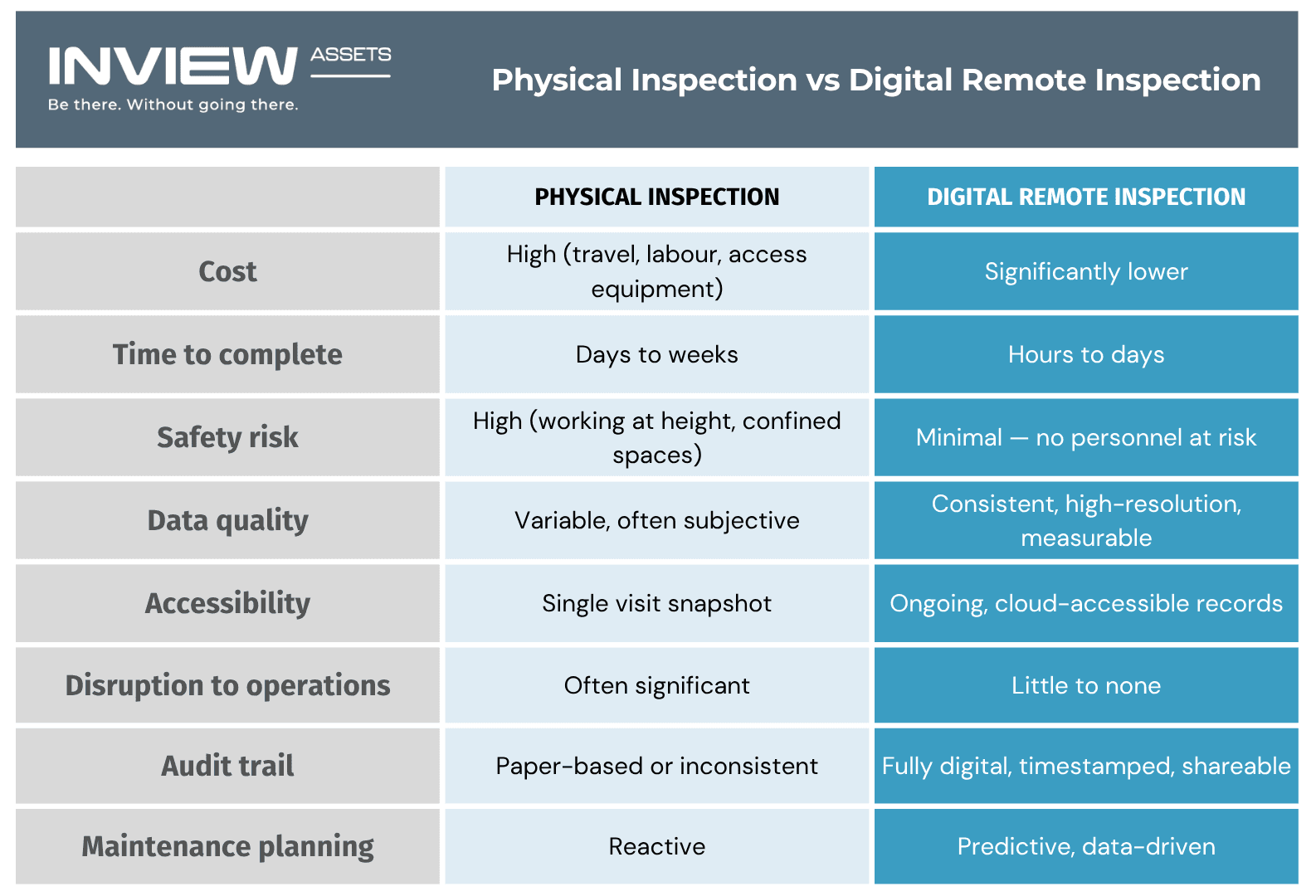
The Key Differences: Side by Side
Cost: The Numbers Speak for Themselves
With petrol and diesel prices in the UK continuing to place pressure on business operating budgets, regularly hovering around or above £1.50 per litre, the cost of getting people to site is an expense that adds up fast.
Add vehicle wear, mileage allowances and travel time, and the true cost of on-site inspections becomes increasingly hard to justify.
A traditional physical inspection of a large commercial building or complex asset can involve:
- Surveyor day rates and travel expenses
- Hire of access equipment such as cherry pickers, scaffolding, or rope access teams
- Building downtime or operational disruption
- Repeat visits if conditions aren’t right or additional areas need checking
- Time spent manually compiling and distributing written reports
When you add these up across a portfolio of buildings, the costs escalate quickly, often running into thousands of pounds per inspection cycle.
Cloud asset management with InView Assets eliminates most of these expenses. There’s no need for costly access equipment, no travel overhead, and no repeated site visits. A single mobilisation can capture extensive data across an entire building envelope, with results delivered rapidly through our digital platform.
For asset managers overseeing multiple properties, the savings across a year can be substantial.
Safety: Removing People from Risk
Beyond cost, there is arguably an even more important reason to embrace digital inspection: keeping your people safe.
Physical inspections of buildings frequently involve working at height, navigating unstable surfaces, entering confined spaces, or accessing areas with structural risk. These are among the most hazardous activities in the built environment, and the UK’s Health and Safety Executive (HSE) consistently identifies falls from height as one of the leading causes of workplace fatalities and serious injuries.
Digital remote inspection fundamentally changes the risk equation. By deploying drone technology, remote sensing equipment, and IoT asset management tools, inspectors never need to set foot in a dangerous location. Data is captured remotely, reviewed safely, and reported on from the ground.
This isn’t just good for your people, it also reduces your organisation’s liability exposure and helps demonstrate a genuine commitment to health and safety best practice.
From Reactive to Predictive: A Smarter Way to Manage Assets
One of the most transformative benefits of digital inspection is the shift it enables from reactive to predictive asset maintenance.
Traditional physical inspections are, by nature, snapshots in time. A surveyor visits, records what they see on the day, and leaves. By the time a defect is noticed, it may already have caused significant damage or worse, a safety incident.
Digital remote inspection, combined with IoT asset management sensors and continuous digital asset tracking, changes this entirely. Technology can now monitor your building data over time, flagging trends and early warning signs before they become costly problems. Instead of waiting for something to fail, you can act on data-driven intelligence scheduling maintenance at the right time, extending asset lifecycles, and allocating budgets with confidence.
This is automated asset management in action: less guesswork, fewer emergencies, and better outcomes for your buildings and the people who use them.
Quality, Consistency, and Digital Asset Optimisation
One concern organisations sometimes raise about digital inspection is whether the quality of information is comparable to an in-person visit. In our experience, it often exceeds it.
High-resolution drone imagery can capture millimetre-level detail on facades and rooftops. Thermal imaging can identify moisture ingress or insulation failure invisible to the naked eye. 360° interior scans create fully navigable digital environments that can be revisited time and again without returning to site.
Physical inspections, by contrast, are only as good as the individual carrying them out. Findings can be subjective, areas can be missed due to access restrictions, and photographs taken on the day may not tell the full story.
With InView Assets, every inspection produces a structured, consistent digital record one that feeds directly into your digital asset optimisation strategy. Assets can be benchmarked across a portfolio, deterioration tracked over time, and capital expenditure planned around real evidence rather than assumptions.
Digital Infrastructure Management at Scale
For organisations managing large or complex estates, digital infrastructure management is no longer optional it’s essential. Whether you oversee a portfolio of commercial properties, a housing association, an NHS trust, or a local authority estate, the ability to centrally manage, track, and report on the condition of your assets is a fundamental operational requirement.
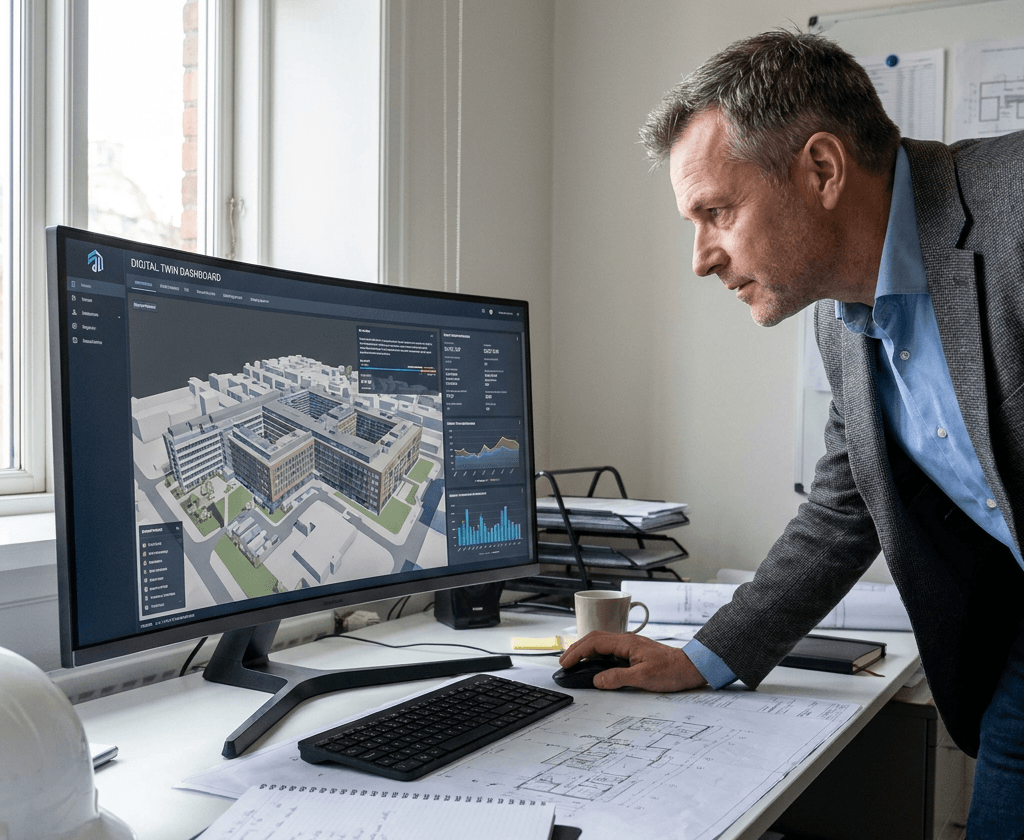
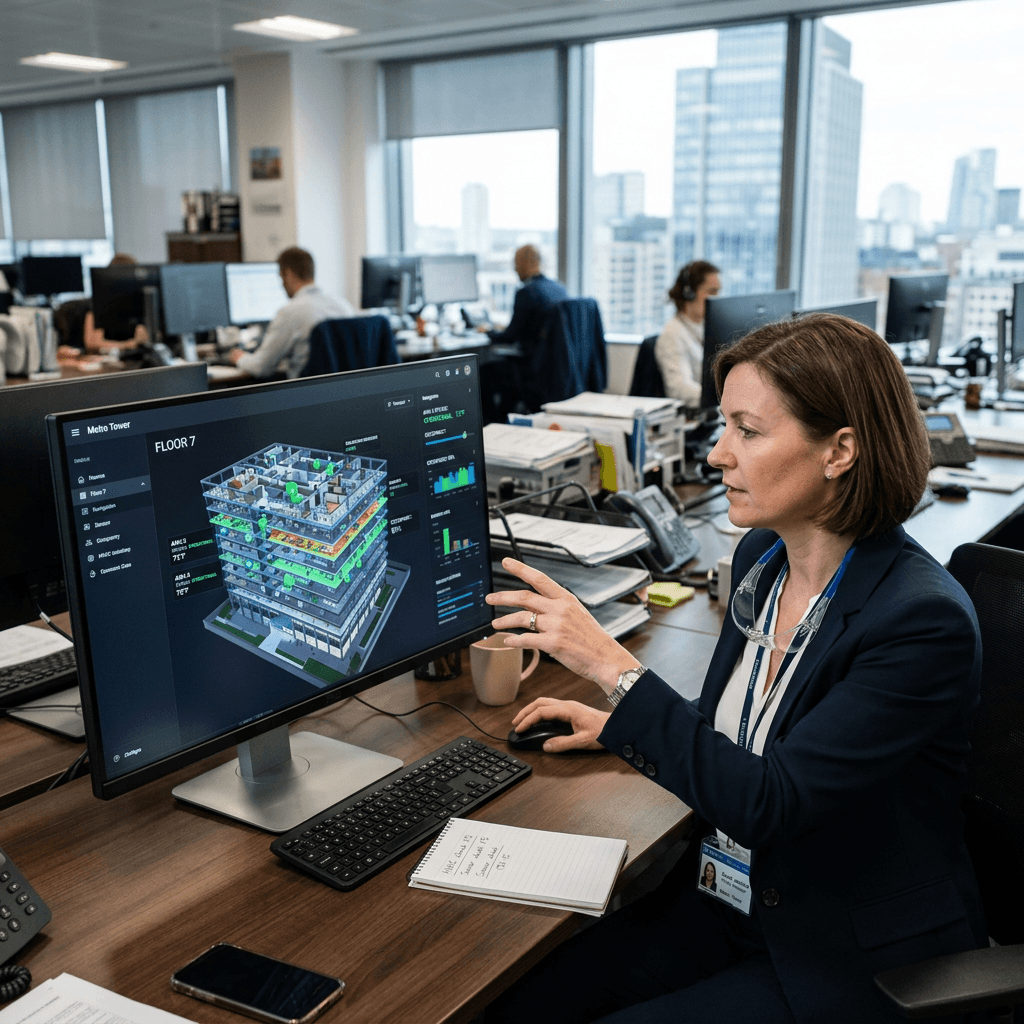
InView Assets’ asset management platform is built for exactly this challenge. All inspection data is stored securely in the cloud, accessible to the right people at the right time, with clear version histories and audit trails. Your entire estate, regardless of size or geography can be viewed, analysed, and acted upon from a single dashboard.
This is the promise of digital transformation in asset management: not just better technology, but genuinely better decisions.
No Disruption. No Downtime.
Physical inspections can cause real disruption to your operations. Scaffolding around a building affects access and appearance. Surveyor presence in plant rooms can interrupt normal use. Tenants or staff may need to be notified, areas vacated, or activities paused.
Digital remote inspections are designed to be as unobtrusive as possible. Drone surveys, for example, can often be conducted without any access to the building interior at all, and with minimal notice or preparation required from your team.
Why InView Assets?
At InView Assets, we’ve built our service around one simple goal: giving you better insight into your building assets with less cost, less risk, and less hassle.
We work with asset managers, facilities teams, housing associations, local authorities, and commercial property owners across the UK to deliver digital asset tracking and inspection solutions that are:
- Comprehensive — full building envelope coverage, inside and out
- Fast — rapid mobilisation and quick turnaround on reports
- Predictive — data that supports proactive, planned maintenance rather than emergency response
- Accessible — all data stored securely on our cloud asset management platform, available to your whole team
- Actionable — clear, prioritised findings that support your maintenance and capital planning
The shift from physical to digital inspection isn’t about replacing expertise it’s about empowering your team with better data, delivered more safely and more affordably than ever before. It is, quite simply, the digital transformation your asset management approach has been waiting for.
Ready to See the Difference?
If you’re curious about what digital remote inspection and cloud asset management could mean for your organisation, we’d love to show you.
Get in touch with the InView Assets team today to discuss your portfolio, request a demonstration, or find out more about how we’re helping UK organisations inspect smarter.
📍 Based in the UK | Serving clients nationwide